Pivoting to the Exponential Playbook
By Mary Mellino | Founder & Principal, RiseMynd
There has never been a more exciting time to build and lead an organization.
The tools and technologies available today make it possible to achieve outcomes that once seemed out of reach. Ten times the impact, at a fraction of the cost. The companies getting there aren't fundamentally different from yours. They've simply adopted a new playbook.
The opportunity is to evolve from a linear model, where growth is proportional to inputs (more resources in, more output out), to an exponential one, where the right combination of technology and innovative practices produces outcomes far greater than the investment required to achieve them.
This isn't about starting over. It's about building a new set of capabilities into how your organization runs. The tools to do this exist right now. Companies using them are unlocking 10x greater outcomes for the same investment of time, money, and effort.
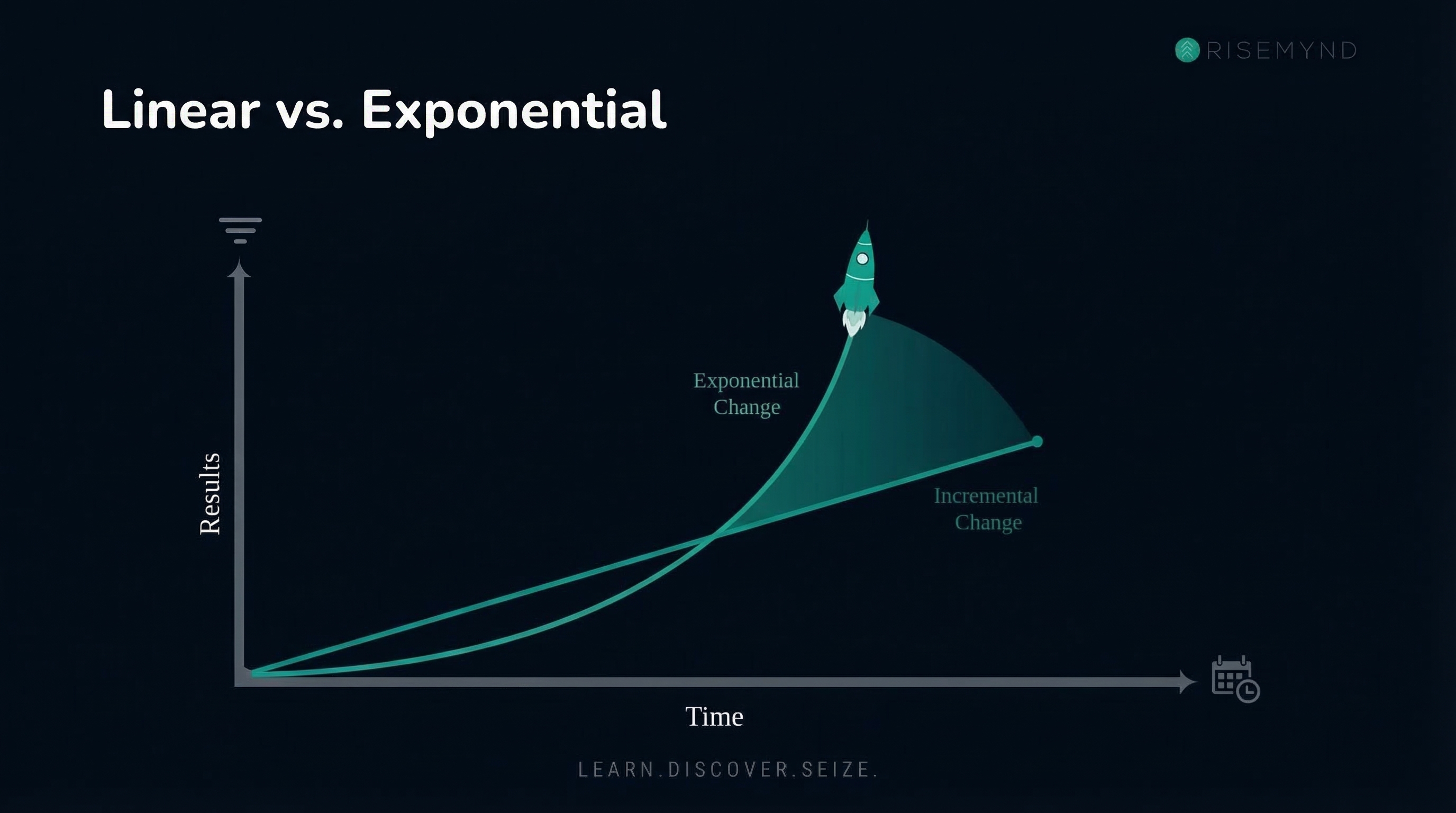
The gap between incremental and exponential change. Same starting point. Very different trajectories.
Companies achieving these outcomes are called Exponential Organizations (ExOs), a term introduced in the groundbreaking book Exponential Organizations by Salim Ismail, Peter H. Diamandis, and Michael S. Malone. The book reveals a proven formula: 11 specific capabilities that, when built into a business and operating model, enable any organization to achieve 10x growth. Each one is buildable, not all at once but one step at a time. Below are all 11 and where to start with each one today.
Start With the Foundation: Massive Transformative Purpose (MTP)
Your MTP is the reason your organization exists beyond the products and services you sell. It's what draws the right talent, customers, and partners to you. Everything else builds from here.
▸ Quick Win: Define a set of core values that go beyond what you deliver. What do you stand for beyond the work itself?
★ Target State: A purpose so bold it goes beyond a mission statement. Your organization aspires to make a real difference for your customers, your industry, and the world.
SCALE: The 5 External Capabilities
Staff on Demand
A trusted pool of skilled talent you can bring in as needed rather than hiring full-time. It keeps your organization flexible and able to grow without adding fixed costs.
▸ Quick Win: Bring in contractors for non-mission-critical areas such as IT, events, or content.
★ Target State: A small full-time core team supported mostly by on-demand talent. Even critical functions are accessed as flexible costs rather than fixed ones.
Community & Crowd
A group of customers, partners, and supporters who are actively involved in your organization. When built well, your community becomes one of your strongest growth drivers.
▸ Quick Win: Start a customer advisory board with your top accounts. Use it to listen, learn, and shape your direction.
★ Target State: Your community runs itself. Customers connect with each other, share ideas, and actively shape what you build next.
Algorithms & AI
Using data, algorithms, and AI to make better decisions, find patterns, and take action without needing a person to drive every step.
▸ Quick Win: Use data collected and analyzed from your existing reporting systems to make decisions.
★ Target State: AI agents make decisions and take action on your behalf without human intervention.
Leveraged Assets
Using assets rather than owning them, even for critical parts of the business. It keeps costs low and gives your organization the freedom to grow without the weight of ownership.
▸ Quick Win: Shift owned infrastructure to cloud computing and replace legacy software with SaaS tools. Two moves most organizations can make right away.
★ Target State: On-demand access even for mission-critical assets. Capital is freed up, overhead stays low, and the business scales without friction.
Engagement
The programs and techniques that turn your broader market into active participants. Done well, engagement drives loyalty, referrals, and growth.
▸ Quick Win: Leverage social media for marketing purposes.
★ Target State: Your products and services are inherently designed to convert the crowd into Community.
IDEAS: The 5 Internal Capabilities
Interfaces
The systems that manage how outside inputs — customer requests, partner data, community ideas — come into your organization and get acted on without creating bottlenecks.
▸ Quick Win: Set up a simple client portal or ticketing tool so incoming requests are visible, assigned, and never fall through the cracks.
★ Target State: Every client touchpoint flows through a system that captures, routes, and responds automatically. No manual handoffs required.
Dashboards
Real-time visibility into what is working. Not reports you read at the end of the quarter but live signals that help you make better decisions today.
▸ Quick Win: Pull live data from your existing CRM or ERP. Identify one metric you can see in real time. Start there.
★ Target State: Every key metric tracked in real time across the organization. Teams set clear goals using OKRs and everyone can see how their work connects to results.
Experimentation
Testing your biggest assumptions before you commit major resources to them. It helps you learn faster, reduce risk, and grow what is actually working.
▸ Quick Win: Identify one hypothesis to solve a problem. Run a sprint to test and learn. Decide to pivot or persevere based on what you find.
★ Target State: A board and C-suite dashboard that tracks all active experiments across the organization, with results tied directly to incentives.
Autonomy
Giving the people closest to the work and the customer the authority to make decisions. Purpose and culture are set at the top. Execution happens at the edge.
▸ Quick Win: Identify one decision that requires your approval but doesn't need to. Transfer it fully to the person best positioned to own it.
★ Target State: Small, self-organizing teams make most key decisions on their own. Leadership focuses on purpose, culture, and vision rather than managing every call.
Social Technologies
The tools that allow your teams, partners, and contractors to share knowledge and work together in real time, no matter where they are.
▸ Quick Win: Pick one collaboration tool and make it the official platform for one team for 30 days. See what changes when information flows openly.
★ Target State: Open collaboration tools are standard practice across the whole organization. Knowledge is shared by default, not by exception.
Where to Start
The path forward is simple: know where you are, pick your highest-leverage gap, and start there. The ExQ (Exponential Quotient) diagnostic scores your organization across all 11 attributes and shows you exactly where to focus first.
The organizations achieving the best results right now aren't the biggest or the oldest. They're the ones that decided to build differently and started.
Let's build.
Ready to find out where your organization scores?
Take the ExQ Survey